



What are the definitions and relationships of stationary contacts, moving contacts, and Phillips head contacts in switchgear?
2026-02-26 16:08:03
In switchgear, stationary and moving contacts are the core components that determine the continuity of a circuit, with the Phillips head contact being the most common structural form of the moving contact. Simply put, the stationary contact is fixed in place, while the moving contact moves with the switchgear (such as a trolley), and the two conduct current through close contact. Due to its unique structure and excellent performance, the Phillips head contact is widely used in medium and high voltage switchgear.
1. Stationary Contact
Definition: A stationary contact is a conductive component fixedly installed on the busbar side or cable side of a switchgear, typically directly connected to the conductive busbar inside the cabinet. It serves as a crucial "relay station" for current flowing into or out of the circuit breaker.
Structure: Stationary contacts are usually made of materials with excellent conductivity (such as copper or copper alloys), and their surface is silver-plated to reduce contact resistance and prevent oxidation. Their shape is often cylindrical or cylindrical to accommodate the moving contact. In some designs, the stationary contact is also coated with insulating materials such as epoxy resin to improve insulation performance and safety.
2. Moving Contact
Definition: A moving contact is a conductive component installed on a movable part (such as the contact arm of a trolley-type circuit breaker). It moves as the circuit breaker is pushed in (closing) or pulled out (opening), and is the key actuator for connecting and disconnecting the circuit.
Relationship with Stationary Contact: In the operating state of the switchgear, the moving contact is inserted into the stationary contact, and the two are tightly fitted together, forming an electrical connection. To ensure reliable contact, the moving contact needs to have a certain "overtravel," meaning it can continue to compress a certain distance after contact to compensate for long-term wear and ensure sufficient contact pressure.
3. Plum Blossom Contact
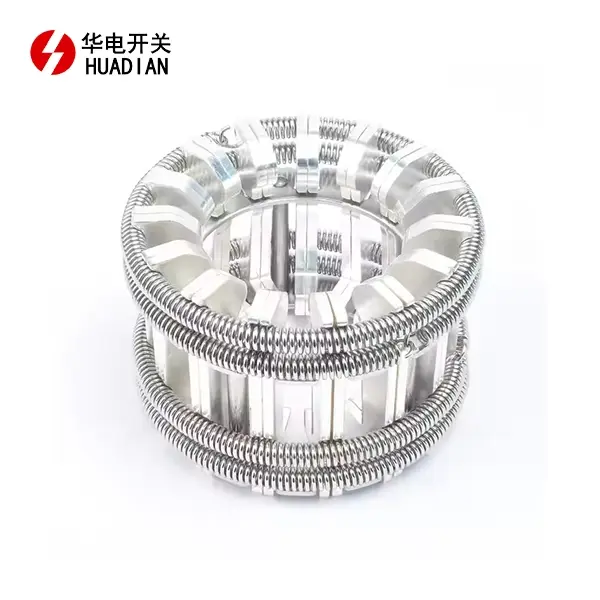
The plum blossom contact is a specific structural form of moving contact, named for its multiple contact fingers arranged in a ring, resembling the petals of a blooming plum blossom. It is currently the most widely used contact type in centrally controlled switchgear and handcart-type circuit breakers.
| Features | Description |
| Structural composition | It mainly consists of three parts: contact plates (contact fingers), support frame, and spring. The contact plates (usually made of T2 copper plate plated with silver) are evenly arranged on the support frame and are tightened by a ring spring (such as a non-magnetic stainless steel spring) to provide contact pressure. |
| Core advantages |
1. Self-cleaning function: During the opening and closing process, the relative movement of the contact fingers and the stationary contact rod can rub away the oxide film, reducing contact resistance. 2. High electrodynamic stability: When a large current (such as a short-circuit current) passes through, the current direction between each contact finger is the same, and the resulting electrodynamic force attracts each other. This increases the pressure between the contact fingers and the stationary contact rod, preventing the contacts from being repelled. 3. Low closing bounce: Because the contact pressure direction is perpendicular to the movement direction of the moving contact, the impact bounce during closing is small, helping to reduce arc erosion. 4. High current carrying capacity: By shunting the current through multiple contact fingers connected in parallel, the number of contact pieces can be adjusted to meet the needs of different current levels (e.g., 12 pieces for 630A, 84 pieces for 4000A). |
Summary of the Relationship Among the Three:
To understand their relationship using a simple analogy:
The circuit connection of the switchgear is like a "plug and socket" connection.
The stationary contact is like a "power socket" on the wall; it is fixed and connected to the electrical wiring (conductive busbar).
The moving contact is like the "power plug" of an appliance; it is inserted into or removed from the socket as the appliance (circuit breaker trolley) moves.
The Phillips-shaped contact is a sophisticated design of this "power plug." It is not simply two copper rods, but consists of multiple spring-loaded "metal petals" (contact fingers) that grip the socket (stationary contact) like claws, ensuring stable and reliable contact and the ability to withstand large currents.
In short, when the circuit breaker trolley is moved into the "working position," the Phillips-shaped contact (moving contact) tightly grips the stationary contact, thus building a solid and reliable "bridge" for the flow of current.
Shaanxi Huadian's contact products are widely used in new energy power transmission lines, power plants and substations, and industrial power distribution systems. They provide core component support for various high-voltage switchgear and are suitable for various applications requiring high-reliability electrical connections. Please contact us if needed.
Email:pannie@hdswitchgear.com
Whatsapp/Wechat:+8618789455087
YOU MAY LIKE