



What are the advantages and disadvantages of various operating mechanisms and their actions in medium-voltage circuit breakers?
2025-11-11 13:11:23
Currently, the commonly used operating mechanisms for medium-voltage circuit breakers in my country mainly include electromagnetic operating mechanisms, spring operating mechanisms, and permanent magnet operating mechanisms. The working principles, performance, advantages, and disadvantages of these operating mechanisms will be discussed below.
1. Electromagnetic operating mechanism
Working principle of electromagnetic operating mechanism: Electromagnetic operating mechanism is a relatively mature and early type of circuit breaker operating mechanism. Its structure is relatively simple, with about 120 mechanical components. It uses the electromagnetic force generated by the current in the closing coil to drive the closing iron core, which strikes the closing linkage mechanism to close the circuit. The magnitude of its closing energy depends entirely on the magnitude of the closing current, so a large closing current is required.
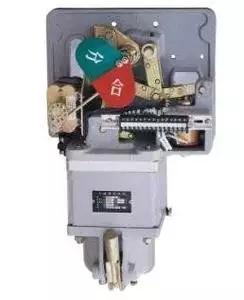
The advantages of electromagnetic operating mechanisms are mainly:
① Relatively simple structure, reliable operation, low processing requirements, easy manufacturing, and low production cost;
② Enables remote control operation and automatic reclosing;
③ Has good closing and opening speed characteristics.
The main disadvantages of electromagnetic operating mechanisms are:
① High closing current and high power consumption of the closing coil, requiring a high-power DC operating power supply;
② Due to the high closing current, ordinary auxiliary switches and relay contacts cannot meet the requirements, necessitating a dedicated DC contactor;
the contactor's contacts with arc-suppression coils are used to control the closing current, thereby controlling the operation of the closing and opening coils;
③ Low operating speed, low contact pressure, prone to contact bounce, long closing time, and significant impact of power supply voltage fluctuations on the closing speed;
④ High material consumption and bulky mechanism;
⑤ The circuit breaker body and operating mechanism of outdoor substations are generally assembled together. This type of integrated circuit breaker typically only has electric closing, electric opening, and manual opening functions, but lacks manual closing functionality. When the operating mechanism box malfunctions and the circuit breaker refuses to operate electrically, power must be cut off for repair.
Electromagnetic operating mechanisms are widely used in some older substations.
This type of intergrated circuit breaker typically only has electric closing,electric opening,and manual opening functions,but lacks manual closing functionality.When the operating mechanism box malfunctions and the circuit breaker refuses to operate electrically,power must be cut off for repair.
2. Spring operating mechanism
The working principle of the spring operating mechanism: The spring operating mechanism consists of four parts: spring energy storage, closing maintenance, opening maintenance, and opening. It comprises approximately 200 components and utilizes the energy stored in the stretching and contraction of the springs within the mechanism to perform the closing and opening operations of the circuit breaker. The storage of spring energy is achieved through the operation of the energy storage motor reduction mechanism, while the closing and opening actions of the circuit breaker are controlled by the closing and opening coils. The key components of the spring operating mechanism are the opening spring and the closing spring. The closing spring stores the mechanical work of the motor in a short time and then releases the closing spring energy to close the circuit. During the opening process, the opening spring stores energy, which is used as the opening power. Therefore, the energy required for the circuit breaker's closing and opening operations depends on the energy stored in the springs and is independent of the magnitude of the electromagnetic force, requiring no large closing or opening current.
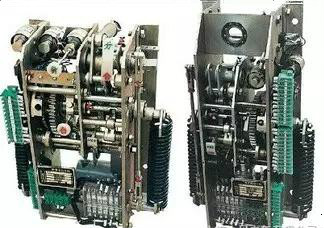
The advantages of spring-operated mechanisms are mainly as follows:
① Low closing and opening currents, eliminating the need for a high-power operating power supply;
② Remote electric energy storage for electric closing and opening, as well as local manual energy storage for manual closing and opening. Therefore, manual closing and opening operations can be performed even when the operating power supply is lost or the operating mechanism refuses to operate electrically;
③ Fast closing and opening speeds, unaffected by power supply voltage fluctuations, and capable of rapid automatic reclosing;
④ Low-power energy storage motor, usable for both AC and DC;
⑤ Spring-operated mechanisms allow for optimal energy transfer matching and enable the same operating mechanism to be used for circuit breakers of various breaking current specifications. Different energy storage springs can be selected, resulting in excellent cost-effectiveness.
The main disadvantages of spring-operated mechanisms are:
① Complex structure, complex manufacturing process, high precision requirements, and high manufacturing cost;
② Large operating force, requiring high component strength;
③ Prone to mechanical failures that cause the operating mechanism to fail to operate. The main reason is that the electric energy storage is insufficient; the spring crank arm has not yet passed its dead position before the limit switch cuts off the power to the energy storage motor, making electric closing impossible. Because the circuit breaker refuses to close after the closing button is pressed, the auxiliary switch cannot promptly disconnect the closing circuit, often causing the closing coil to remain energized for an extended period, burning out the closing coil or the limit switch;
④ False tripping occurs; sometimes, after a false trip, the circuit breaker does not open properly, making it impossible to determine the opening or closing position;
⑤ Poor opening speed characteristics.
Spring-operated mechanisms overcome many of the disadvantages of electromagnetic operating mechanisms and are currently widely used in power distribution systems.
3. Permanent magnet operating mechanism
Working principle of permanent magnet operating mechanism: Addressing the shortcomings of electromagnetic and spring operating mechanisms, a new type of circuit breaker operating mechanism has been developed and produced: the permanent magnet operating mechanism. The permanent magnet operating mechanism adopts a completely new working principle and structure, consisting of a permanent magnet, a closing coil, and a opening coil. It eliminates the moving links, tripping, and locking devices found in spring and electromagnetic operating mechanisms, resulting in a simple structure with very few parts (approximately 50). During operation, only one main moving part exists, ensuring high reliability. It utilizes a permanent magnet to maintain the circuit breaker position, making it an electromagnetically operated, permanently magnet-held, and electronically controlled operating mechanism.
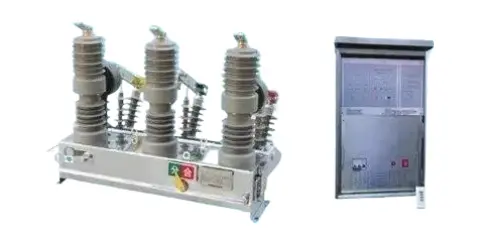
The main advantages of permanent magnet operating mechanisms are:
① They employ a bistable, dual-coil mechanism. The permanent magnet operating mechanism achieves opening and closing operations through a coil. The permanent magnet works in conjunction with the coil, effectively solving the problem of requiring high power energy for opening and closing. Because the magnetic field energy provided by the permanent magnet can be used for the opening and closing operation, the energy required by the coil is reduced, thus eliminating the need for a large operating current.
② The up-and-down movement of the moving iron core, via a crank arm and insulating pull rod, acts on the moving contact of the circuit breaker's vacuum interrupter, achieving the opening or closing of the circuit breaker. This replaces the traditional mechanical locking method, greatly simplifying the mechanical structure, reducing consumables, lowering costs, reducing potential failure points, significantly improving the reliability of mechanical action, and enabling maintenance-free operation, saving on repair costs.
③ The permanent magnet force in the permanent magnet operating mechanism almost never disappears, with a lifespan of up to 100,000 cycles. Using electromagnetic force for opening and closing operations and permanent magnet force for bistable position holding simplifies the transmission mechanism, reduces energy consumption and noise, and has a lifespan more than three times longer than electromagnetic and spring operating mechanisms.
④ Utilizing contactless, non-moving, wear-free, and non-bouncy electronic proximity switches as auxiliary switches eliminates contact problems, ensures reliable operation, is unaffected by external environments, boasts a long lifespan, and high reliability, resolving contact bounce issues.
⑤ Employing synchronous zero-crossing switching technology. Under the control of the electronic control system, the circuit breaker's moving and stationary contacts close when the system voltage waveform crosses zero and open when the current waveform crosses zero, generating very small inrush currents and overvoltages, reducing the impact of operation on the power grid and equipment. In contrast, electromagnetic and spring operating mechanisms operate randomly, generating very large inrush currents and overvoltages, resulting in greater impact on the power grid and equipment.
⑥ The permanent magnet operating mechanism enables local/remote opening and closing operations, as well as protective closing and reclosing functions, and allows for manual opening. Because the required power capacity is small, a capacitor is used as the direct power source for tripping and closing. The capacitor has a short charging time, low charging current, and strong impact resistance, allowing for circuit breaker opening and closing operations even after a power outage.
⑦ No "intermediate state". "Intermediate state" refers to the circuit breaker failing to close properly due to various reasons, causing serious power system failure. The permanent magnet operating mechanism adopts the "two-position" principle in its design, and its moving iron core is either in the open position or in the closed position, without any intermediate state of being half-closed.
The main disadvantages of permanent magnet operating mechanisms are:
① They cannot be manually closed. If the capacitor is depleted after the operating power is lost, and the capacitor cannot be recharged, the closing operation cannot be performed.
② When manually opening, a sufficiently high initial opening speed is required, necessitating significant force; otherwise, the opening operation cannot be performed.
③ The quality of the energy storage capacitors is inconsistent and difficult to guarantee.
④ It is difficult to obtain ideal opening speed characteristics.
⑤ It is difficult to improve the opening output power of the permanent magnet operating mechanism.
Summary
Permanent magnet operating mechanisms are a new type of operating mechanism, currently beginning to be used in medium-voltage vacuum circuit breakers. With technological advancements, permanent magnet operating mechanisms will continue to mature.
In summary, the appropriate medium-voltage circuit breaker operating mechanism can be selected based on different environments. If you have any questions regarding power engineering, please contact Shaanxi Huadian promptly; Shaanxi Huadian will reply to you as soon as possible.
Email:pannie@hdswitchgear.com.
Whatsapp/Wechat:+8618789455087
YOU MAY LIKE