



What are the characteristics of surge arresters and how are they used?
2026-01-12 14:50:19
Surge arresters: Electrical equipment is protected from high transient overvoltages caused by lightning strikes, and its follow current duration and amplitude are limited. Surge arresters are sometimes also called overvoltage protectors or overvoltage limiters. Features: High transient, overvoltage, electrical, lightning protection.
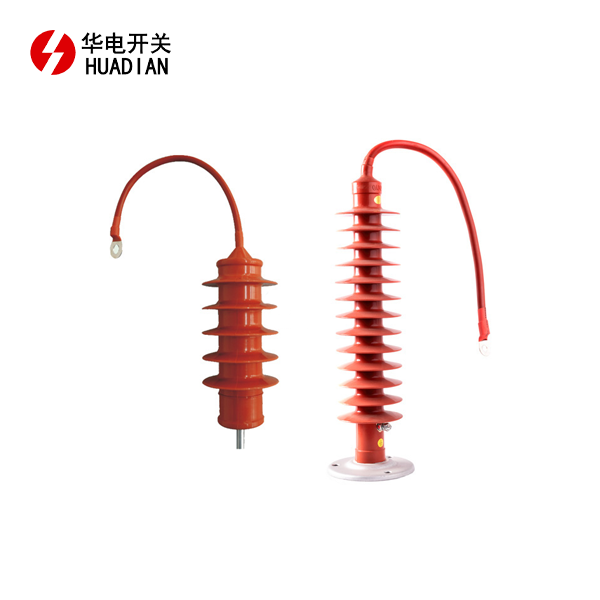
Scope of Application
AC gapless metal oxide surge arresters are used to protect the insulation of AC power transmission and transformation equipment from damage caused by lightning overvoltage and switching overvoltage. They are suitable for overvoltage protection of transformers, transmission lines, distribution panels, switchgear, power metering boxes, vacuum switches, parallel compensation capacitors, rotating motors, and semiconductor devices.
Features and Principle
AC gapless metal oxide surge arresters possess excellent nonlinear volt-ampere characteristics, good response characteristics, no follow current, large current capacity, low residual voltage, strong overvoltage suppression capability, pollution resistance, aging resistance, no altitude restrictions, simple structure, gapless design, tight sealing, and long service life.
Under normal system operating voltage, this surge arrester exhibits a high resistance state, with only microampere-level current flowing through it. Under the action of overvoltage and large current, it exhibits low resistance, thereby limiting the residual voltage across the arrester.
Classification
Surge arresters are classified into many types, including metal oxide surge arresters, line-type metal oxide surge arresters, gapless line-type metal oxide surge arresters, fully insulated composite-jacketed metal oxide surge arresters, and detachable surge arresters.
The main types of surge arresters include tubular surge arresters, valve-type surge arresters, and zinc oxide surge arresters. While the main working principles of each type differ, their essential function is the same: to protect communication cables and equipment from damage.
Tubular Surge Arresters
A tubular surge arrester is essentially a protective gap with high arc-extinguishing capability. It consists of two gaps connected in series. One gap, called the outer gap, is in the atmosphere and its function is to isolate the working voltage, preventing the gas-generating tube from being burned out by the power frequency leakage current flowing through it. The other gap, called the inner gap or arc-extinguishing gap, is installed inside the gas tube. The arc-extinguishing capability of a tubular surge arrester is related to the magnitude of the power frequency follow current. This is a type of protective gap surge arrester, mostly used for lightning protection on power lines.
Valve-type surge arresters consist of a spark gap and a valve resistor, with the valve resistor made of special silicon carbide. The silicon carbide valve resistor effectively protects against lightning and high voltage, safeguarding equipment. When a lightning strikes with high voltage, the spark gap breaks down, the valve resistor's resistance decreases, and the lightning current is diverted to the ground, protecting cables or electrical equipment from damage. Under normal conditions, the spark gap will not break down, and the valve resistor's high resistance will not affect normal communication lines.
Zinc oxide surge arresters are high-performance, lightweight, pollution-resistant, and stable surge protection devices. They primarily utilize the excellent nonlinear voltage-current characteristics of zinc oxide, resulting in extremely low current flow (microamps or milliamps) under normal operating voltage. When overvoltage occurs, the resistance drops sharply, discharging the overvoltage energy and achieving protection. The difference between this type of arrester and traditional surge arresters is that it lacks a discharge gap, relying instead on the nonlinear characteristics of zinc oxide for current discharge and interruption. The above introduces several types of surge arresters. Each surge arrester has its own advantages and characteristics, and they need to be used in different environments to achieve good lightning protection effects.
Function
A surge arrester is connected between the cable and the ground, usually in parallel with the protected equipment. Surge arresters effectively protect communication equipment. In the event of abnormal voltage, the surge arrester will activate, providing protection. When the communication cable or equipment is operating under normal operating voltage, the surge arrester does not function and is considered an open circuit to the ground. However, if a high voltage occurs that threatens the insulation of the protected equipment, the surge arrester will immediately activate, diverting the high-voltage surge current to the ground, thereby limiting the voltage amplitude and protecting the insulation of the communication cable and equipment. Once the overvoltage dissipates, the surge arrester quickly returns to its original state, allowing the communication line to operate normally.
Therefore, the main function of a surge arrester is to reduce the amplitude of the intruding surge wave through the action of a parallel discharge gap or nonlinear resistor, thereby reducing the overvoltage value experienced by the protected equipment and protecting communication lines and equipment.
Surge arresters can be used not only to protect against high voltages generated by lightning but also to protect against operational high voltages.
Seven Key Characteristics
I. High Current Carrying Capacity of Zinc Oxide Surge Arresters
This is mainly reflected in the arrester's ability to absorb various lightning overvoltages, power frequency transient overvoltages, and switching overvoltages. The zinc oxide surge arresters produced by Chuantai fully meet or even exceed national standards. Indicators such as line discharge class, energy absorption capacity, 4/10 nanosecond high-current impulse withstand, and 2ms square wave current carrying capacity have reached a leading level in China.
II. Excellent Protection Characteristics of Zinc Oxide Surge Arresters
Zinc oxide surge arresters are electrical products used to protect various electrical equipment in power systems from overvoltage damage, possessing excellent protective performance. Because the nonlinear voltage-current characteristics of zinc oxide varistors are excellent, only a few hundred microamperes of current flow under normal operating voltage, allowing for a gapless structure design, resulting in good protection performance, light weight, and small size. When overvoltage occurs, the current flowing through the varistor increases rapidly, simultaneously limiting the amplitude of the overvoltage and releasing the overvoltage energy. Afterwards, the zinc oxide varistor returns to a high-resistance state, allowing the power system to operate normally.
III. Good Sealing Performance of Zinc Oxide Surge Arresters
The arrester components use high-quality composite casings with good aging resistance and airtightness. Measures such as controlling the compression of the sealing ring and applying sealant are used, and the ceramic casing is used as a sealing material to ensure reliable sealing and stable performance of the arrester.
IV. Mechanical Performance of Zinc Oxide Surge Arresters
The following three factors are mainly considered:
⑴ Seismic force withstood;
⑵ Maximum wind pressure acting on the arrester;
⑶ Maximum allowable tensile force of the conductor at the top of the arrester.
V. Good Anti-Pollution Performance of Zinc Oxide Surge Arresters
Gapless zinc oxide surge arresters have high resistance to pollution.
Currently, the creepage distance levels specified by national standards are:
⑴ Level II: Medium pollution areas: creepage distance 20mm/kV
⑵ Level III: Heavy pollution areas: creepage distance 25mm/kV
⑶ Level IV: Extremely heavy pollution areas: creepage distance 31mm/kV
VI. High Operating Reliability of Zinc Oxide Surge Arresters
The long-term reliability depends on the product quality and the appropriateness of product selection. The product quality is mainly affected by the following three aspects:
A. The rationality of the overall structure of the surge arrester;
B. The voltage-current characteristics and aging resistance characteristics of the zinc oxide varistor;
C. The sealing performance of the surge arrester.
VII. Power Frequency Withstand Capability
Due to various reasons in the power system, such as single-phase grounding, long-line capacitance effects, and load shedding, the power frequency voltage may increase or high-amplitude transient overvoltages may occur. The surge arrester has the ability to withstand a certain power frequency voltage increase for a certain period of time.
Usage
1. Should be installed near the distribution transformer.
Metal oxide surge arresters (MOA) are connected in parallel with the distribution transformer during normal operation, with the upper end connected to the line and the lower end grounded. When an overvoltage occurs on the line, the distribution transformer will bear the three-part voltage drop generated by the overvoltage passing through the surge arrester, connecting wires, and grounding device, which is called the residual voltage. Of these three parts of overvoltage, the residual voltage across the surge arrester is related to its own performance, and its value is constant. The residual voltage on the grounding device can be eliminated by connecting the grounding lead to the transformer casing and then connecting it to the grounding device. Therefore, reducing the residual voltage on the connecting wires becomes crucial for protecting the distribution transformer. The impedance of the connecting wires is related to the frequency of the current passing through them; the higher the frequency, the stronger the inductance of the wire, and the greater the impedance. From U=IR, to reduce the residual voltage on the connecting wires, the impedance of the connecting wires must be reduced. A feasible method to reduce the impedance of the connecting wires is to shorten the distance between the MOA and the distribution transformer, thereby reducing the impedance of the connecting wires and lowering the voltage drop. Therefore, it is more appropriate to install the surge arrester closer to the distribution transformer.
2. Should also be installed on the low-voltage side of the distribution transformer.
If no MOA is installed on the low-voltage side of the distribution transformer, when the high-voltage side surge arrester discharges lightning current to the ground, a voltage drop is generated on the grounding device. This voltage drop acts on the neutral point of the low-voltage winding through the transformer casing. Therefore, the lightning current flowing through the low-voltage winding will induce a very high potential (up to 1000 kV) in the high-voltage winding according to the transformation ratio. This potential will be superimposed on the lightning voltage of the high-voltage winding, causing the potential of the neutral point of the high-voltage winding to rise, leading to insulation breakdown near the neutral point. If an MOA is installed on the low-voltage side, when the high-voltage side MOA discharges and the potential of the grounding device rises to a certain value, the low-voltage side MOA starts to discharge, reducing the potential difference between the output terminal of the low-voltage winding and its neutral point and casing. This eliminates or reduces the effect of the "reverse transformation" potential.
3. The MOA grounding wire should be connected to the transformer casing.
The grounding wire of the MOA should be directly connected to the casing of the distribution transformer, and then the casing should be connected to the ground. It is incorrect to connect the lightning arrester's grounding wire directly to the ground and then run another grounding wire from the grounding stake to the transformer casing. Additionally, the grounding wire of the lightning arrester should be as short as possible to reduce residual voltage.
4. Strictly follow the regulations for regular inspection and testing.
Regularly measure the insulation resistance and leakage current of the MOA. If the insulation resistance of the MOA is found to be significantly reduced or broken down, it should be replaced immediately to ensure the safe and reliable operation of the distribution transformer.
Operation and Maintenance
During daily operation, the pollution level of the surge arrester's porcelain insulator surface should be checked, as severe pollution can lead to uneven voltage distribution. In surge arresters with parallel shunt resistors, an increase in voltage distribution across one element will significantly increase the current through its parallel resistor, potentially burning out the resistor and causing a fault. This can also affect the arc extinguishing performance of valve-type surge arresters. Therefore, the surge arrester's porcelain insulator surface must be cleaned promptly if it is severely contaminated.
Inspect the surge arrester's leads and grounding down conductors for burn marks, broken strands, and check the discharge recorder for signs of burnout. This inspection is the easiest way to detect hidden defects in the surge arrester. Check the sealing at the upper lead of the surge arrester; poor sealing can lead to water ingress and moisture, easily causing accidents. Therefore, the cement joint between the porcelain insulator and the flange should be checked for tightness. A waterproof cover can be installed on the upper lead of 10 kV valve-type surge arresters to prevent rainwater from seeping in. Check whether the electrical distance between the surge arrester and the protected electrical equipment meets the requirements. The surge arrester should be as close as possible to the protected electrical equipment. After a thunderstorm, the operation of the discharge recorder should be checked. Check the leakage current; if the power frequency discharge voltage is greater than or less than the standard value, maintenance and testing should be performed. If the discharge recorder activates too many times, maintenance should be performed. If there are cracks in the porcelain insulator and cement joint, or if the flange and rubber gasket are loose, maintenance should be performed.
The insulation resistance of the surge arrester should be checked regularly. A 2500-volt insulation tester should be used for measurement. If the measured value shows no significant change compared to the previous result, it can continue to be used. A significant decrease in insulation resistance is generally caused by poor sealing and moisture ingress or short circuits in the spark gap. If it falls below the acceptable value, a characteristic test should be performed. A significant increase in insulation resistance is generally caused by poor contact or breakage of internal parallel resistors, as well as spring relaxation and separation of internal components.
To promptly detect hidden defects inside valve-type surge arresters, a preventive test should be conducted before each thunderstorm season.
Contact Us
Shaanxi Huadian Surge Arrester provides customized protection solutions for different voltage levels and special environmental requirements, covering a wide range of applications including ultra-high voltage power transmission, new energy power plants, rail transit, and data centers. Please contact us for inquiries.
Email:pannie@hdswitchgear.com.
Whatsapp/Wechat:+8618789455087
YOU MAY LIKE