



What are the common fault prevention and handling methods for 10kV vacuum circuit breakers?
2025-12-12 16:34:57
As a core protection and control device in medium-voltage power distribution systems, the stable operation of 10kV vacuum circuit breakers is crucial. The following are prevention and handling methods for common faults, presented in a clear and focused manner.
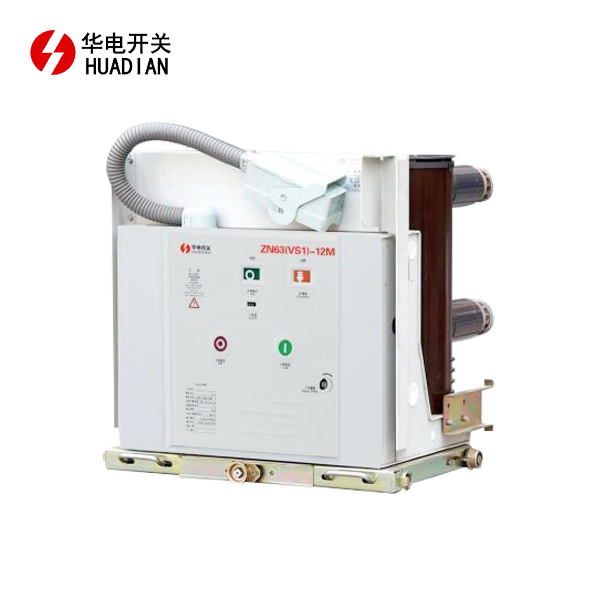
I. Common Fault Types and Handling Methods
1. Vacuum Interruptor Fault (Core Component)
Fault Symptoms:
Vacuum level decreases, manifested as the arc failing to extinguish (continuous arcing) when the circuit breaker trips, accompanied by internal flashes or abnormal sounds.
Breakdown occurs during withstand voltage testing.
Under power outage conditions, the power frequency withstand voltage test on the break point fails.
Handling Methods:
Replace the vacuum interruptor immediately. Vacuum level is irreversible; once it fails, the entire interruptor must be replaced.
After replacement, the contact stroke, overtravel, and opening distance must be strictly adjusted.
2. Mechanical Characteristic Faults
Fault Symptoms:
Opening/closing speed does not meet requirements:Excessive speed can easily cause overvoltage, while insufficient speed can lead to excessively long arcing time.
Excessive bounce time (mainly closing bounce):Increases contact wear, easily causing operational overvoltage and welding.
Poor three-phase synchronization:Leads to incomplete phase opening and closing, affecting system stability and negatively impacting loads such as transformers.
Remedies:
Use a circuit breaker mechanical characteristic tester for measurement and analysis.
Check and adjust the pre-compression force of the opening and closing springs.
Check for wear, jamming, or poor lubrication of components such as transmission links, pins, and buffers; clean, lubricate, or replace as needed.
Adjust contact overtravel and linkage mechanism to ensure three-phase synchronization.
3. Operating Mechanism Failure (Spring Mechanism as an Example)
a. Refusal to Operate (Refusal to Open or Close)
Possible Causes and Solutions:
Electrical Circuit Problems: Check if the control power supply voltage is normal; check if the opening/closing coil is burnt out (measure resistance); check if the auxiliary switch (normally open/normally closed contact) is switched in place and making good contact; check if the secondary wiring terminals are loose.
Mechanical Jamming Problems: Check for foreign objects, deformed parts, or dried lubricant inside the mechanism; check if key fastening components such as the trip half-shaft and latch are worn or poorly fitted.
b. Misoperation Failure (Self-Opening or Closing)
Possible Causes and Solutions:
Check if there are parasitic circuits or two-point grounding in the control circuit.
Check if the opening/closing command pulse has been accidentally introduced.
Check if the tripping component of the mechanism has tripped accidentally due to vibration or other reasons.
c. Energy Storage Failure
Possible Causes and Solutions:
Check if the energy storage motor is damaged (measure resistance), and if the power supply is normal.
Check the energy storage chain and gears for jamming, detachment, or slippage.
Check if the limit switch (microswitch) position is improperly adjusted, causing the motor to fail to stop in time.
4. Insulation Fault
Fault Symptoms:
Surface creepage, flashover, or internal breakdown occurs on support insulators, tie rods, bushings, etc.
Phase-to-phase or phase-to-ground flashover occurs.
Remedies:
After power outage, clean the insulator surfaces to remove contaminants. In heavily polluted areas, apply anti-flashover coating (RTV).
Inspect insulation components for cracks or damage; replace if present.
Check for small animals, condensation, or foreign objects inside the cabinet that could cause insufficient insulation distance.
5. Overheating of Conductive Circuit
Fault Symptoms:
Infrared thermometer shows abnormally high temperatures at terminals, flexible connections, contact arms, etc.
Prolonged overheating may lead to ablation or even arcing short circuits.
Remedies:
Power outage, inspect and tighten all electrical connection bolts (to standard torque).
Inspect the Phillips head contacts or fixed contacts for increased contact resistance due to insufficient contact pressure, oxidation, or burning; clean, polish, or replace if necessary.
For main contacts built into the arc-extinguishing chamber, overheating usually means that the vacuum level has decreased or the lifespan has ended, and the arc-extinguishing chamber needs to be replaced.
II. Core Preventive Measures (Mainly Maintenance and Upkeep)
Strictly Implement Regular Preventive Tests:
Perform insulation resistance measurement, main circuit resistance measurement (DC resistance test), and mechanical characteristic tests (opening and closing speed, synchronization, and bounce) at least once a year.
Perform a power frequency withstand voltage test every 1-3 years or according to regulations to verify the vacuum degree and overall insulation strength of the vacuum interrupter.
In conjunction with power outage opportunities, use a vacuum degree tester (magnetic discharge method) to quantitatively test the interrupter, establish data archives, and predict its lifespan.
Strengthen Daily Inspections and Condition Monitoring:
Observation: Check the circuit breaker for rust, cracks, and abnormal discharge traces.
Listening: Listen for any abnormal sounds during opening and closing.
Temperature Measurement: Regularly use an infrared thermal imager to measure the temperature of each connection point in the conductive circuit to promptly detect potential overheating hazards.
Indicator Check: Verify the accuracy of the opening and closing position and energy storage status indicators.
Key Component Maintenance:
Operating Mechanism: Clean and lubricate the mechanism regularly (usually every 2-3 years or after the specified number of operations), and check for wear on fasteners and connecting parts.
Conductive Connections: Tighten external electrical connection bolts annually during a power outage.
Insulation Components: Keep clean and dry, and check for contamination, especially before humid or dusty seasons.
Standardized Operation and Management:
Avoid frequent operation and ensure the number of short-circuit current interruptions does not approach the rated value.
Record the current and number of short-circuit trips to provide a basis for assessing contact life.
Establish comprehensive equipment technical files, including factory data, historical test data, maintenance records, etc.
III. General Fault Handling Procedure
Safety Isolation: Ensure the circuit breaker is in the "maintenance position," disconnect all control and energy storage power supplies, test for voltage, and connect a grounding wire.
Phenomenon Analysis: Based on fault indicator lights, protection signals, and on-site phenomena (such as unusual odors or noises), preliminarily determine the fault range (electrical circuit/mechanical part).
Segmented Troubleshooting:
Electrical Circuit: From power supply → control switch → protection relay/PLC → terminal block → coil → auxiliary switch, measure voltage and continuity step by step.
Mechanical Part: Manually and slowly store energy, open and close the circuit, feel the resistance, and observe whether each component operates smoothly and in the correct position.
Repair and Verification: Replace damaged parts and adjust parameters. After repair, first perform manual and electric no-load operation tests. After normal operation, perform necessary electrical tests (such as DC resistance and low-voltage operation tests) before finally putting the circuit breaker into operation.
In summary, the management of 10kV vacuum circuit breakers should shift from "reactive maintenance" to "predictive maintenance." Regular comparison of test data, daily condition monitoring, and strict operation and maintenance procedures can effectively prevent the vast majority of faults and significantly improve power supply reliability. When a fault occurs, a systematic investigation and handling process should be conducted, following the principle of "checking electrical first, then mechanical; external first, then internal." Replacement of core components (such as the vacuum interrupter) and adjustment of mechanical parameters are recommended to be performed by qualified personnel.
Contact Us
Shaanxi huadian's vacuum circuit breakers extremely reliable protection and interruption capabilities erect a solid defense line for the power grid, preventing unexpected power outages caused by equipment failure. The optimized spring-operated mechanism ensures reliable operation, a mechanical lifespan of tens of thousands of cycles, and an ultra-long maintenance-free period. Please contact us if interested.
Email:pannie@hdswitchgear.com.
Whatsapp/Wechat:+8618789455087
YOU MAY LIKE