



What do the anti-pumping and interlocking functions mean in a VS1 high-voltage vacuum circuit breaker?
2025-12-17 14:25:16
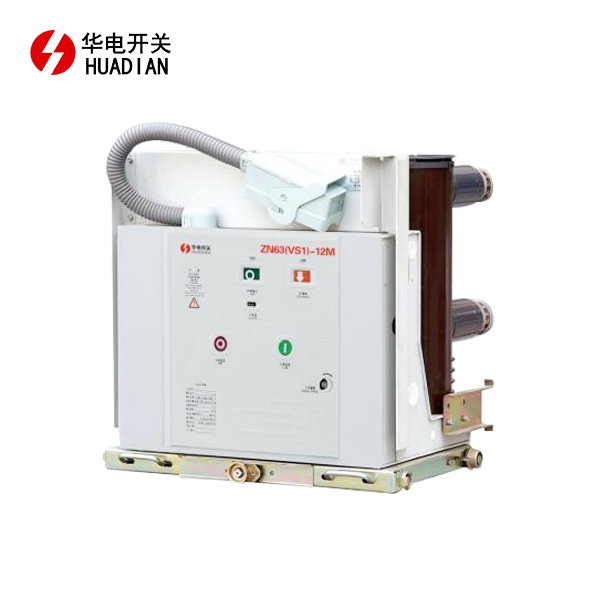
In short:
Anti-pumping: Prevents the circuit breaker from repeatedly cycling through "trip-close-trip" due to a fault while a closing command remains in effect, thus protecting equipment and the system.
Locking: Completely prevents the circuit breaker from performing closing or opening operations when the circuit breaker itself or its operating mechanism malfunctions, preventing accidents.
Detailed breakdown follows:
I. Anti-pumping
1. Definition and Scenarios
Anti-pumping is an electrical interlocking protection function specifically designed to prevent circuit breakers from closing to permanently faulty lines.
Typical Scenario: An operator or automatic device issues a "close" command (this command may persist for an extended period due to a stuck button, stuck relay contacts, or continuous issuance of the command), and the circuit breaker closes. If a permanent short-circuit fault exists on the line, the relay protection device will immediately activate, issuing a "trip" command to open the circuit breaker. If the closing command persists, the circuit breaker will close again to the fault point, and the protection will trip again… This cycle repeats repeatedly, known as "circuit breaker tripping."
2. Hazards
Damage to Circuit Breakers: Repeated closing to short-circuit currents can severely damage core components such as the vacuum interrupter and contacts due to electrodynamic and thermal effects.
Impact on the Power System: Repeated short-circuit current surges can threaten power grid stability and the safety of other equipment.
Damage to Operating Mechanisms: Frequent closing and opening operations can impact mechanical components, leading to fatigue or damage to the mechanism.
3. Principle of Anti-pumping Implementation
The anti-pumping function typically consists of an anti-pumping relay (a double-coil or single-coil holding relay) and related circuits.
Working Process: When the circuit breaker receives a trip signal, the anti-pumping relay is simultaneously activated and self-holding. As long as the closing command persists, the normally closed contact of the anti-pumping relay will disconnect the closing circuit, invalidating subsequent closing commands. Only after the closing command is completely released will the anti-pumping relay reset, and the closing circuit be reconnected.
Essence: It ensures that after one "closing-opening" operation cycle, even if the closing signal is still present, the circuit breaker will only trip once and will be locked in the open state until the closing signal is released.
4. Importance
Anti-pumping is an essential function for circuit breakers to protect themselves and the system, and it is a mandatory requirement in national standards and industry specifications.
II. Interlocking (Blocking)
The term "interlocking" has a broader meaning, referring to a series of mechanical or electrical locking measures used to prevent circuit breakers from operating malfunctions under unsafe conditions. Common interlocking mechanisms for VS1 circuit breakers include:
1. Electrical Interlocking:
These use auxiliary contacts, relays, etc., to form a logic circuit, prohibiting operation.
Spring Operating Mechanism Interlocking:
Closing Spring Not Charged Interlocking: When the spring is not tensioned (charged), the closing circuit is locked to prevent slow closing speed and contact burnout due to insufficient energy.
Opening Spring Not Charged Interlocking (available on some models): Ensures sufficient energy for reliable opening.
Low Voltage Interlocking: When the operating power supply (DC or AC) voltage is too low, closing and opening operations are locked to prevent unreliable operation (e.g., incomplete closing or slow opening) due to insufficient electromagnetic force or motor power.
Interlocking:
Interlocking with grounding switch: When the grounding switch is in the closed position, the circuit breaker is locked from closing to prevent energization with the ground wire connected.
Interlocking with disconnecting switch: In some wiring configurations, this ensures that the disconnecting switch can only be operated when the circuit breaker is in the open position.
Dual power supply line interlocking: Prevents circuit breakers from closing simultaneously from two power supplies, thus avoiding backfeeding or parallel operation accidents (requires a PLC or dedicated interlocking device).
2. Mechanical Interlocking
Locking achieved through a purely mechanical structure.
Tractor Position Interlocking: For center-mounted circuit breakers (such as VS1 in the KYN28 cabinet), closing operations can only be performed when the trolley is in the "working position" or "test position." In the "maintenance position" or during movement, the mechanical device will block the closing button or transmission components.
Opening/Close Position Mechanical Locking: Some circuit breakers are equipped with mechanical padlock holes, which can lock the circuit breaker in the open position during maintenance to prevent accidental closing and ensure personnel safety.
III. Summary of Core Differences
| Features | Anti-bounce | Locking |
|---|---|---|
| Main purpose | Prevents multiple "close-open" cycles caused by a persistent command. | Prevents accidental operation under unsafe conditions of the device or system. |
| Triggering conditions | A trip occurs while the closing command persists. | Multiple conditions: spring not charged, low voltage, incorrect handcart position, presence of grounding switch, etc. |
| Target audience | Primarily locks out the closing circuit. | Can lock closing circuits, opening circuits, or mechanical components. |
| Essence | A specific, mandatory electrical protection logic. | A summary of a series of safety condition judgments (including mechanical and electrical). |
| Analogy | Similar to a car's "anti-restart" function: with the engine running, the starter motor won't restart even if you keep turning the key. | Similar to various safety locks in a car: gear shifting is not possible without applying the brakes (P-gear lock), automatic door locking is prevented at high speeds (automatic door locking while driving), hood lock, etc. |
Conclusion
For the VS1 high-voltage vacuum circuit breaker:
"Anti-pumping" is the "internal fuse" protecting the circuit breaker from repeated impacts from its own components.
"Interlocking" is the "external rule and lock" ensuring the circuit breaker operates safely.
These two functions complement each other, forming the foundation for the safe and reliable operation of the vacuum circuit breaker. During operation and maintenance, it is essential to ensure that these functions are intact and effective.
Shaanxi Huadian vacuum circuit breakers feature multiple safety interlocks, including anti-pumping, interlocking, and undervoltage protection, preventing misoperation and ensuring equipment and personnel safety. The operating mechanism is highly coordinated with the circuit breaker body, resulting in a compact structure, high transmission efficiency, and precise and reliable operation. For inquiries, please contact:pannie@hdswitchgear.com.
YOU MAY LIKE